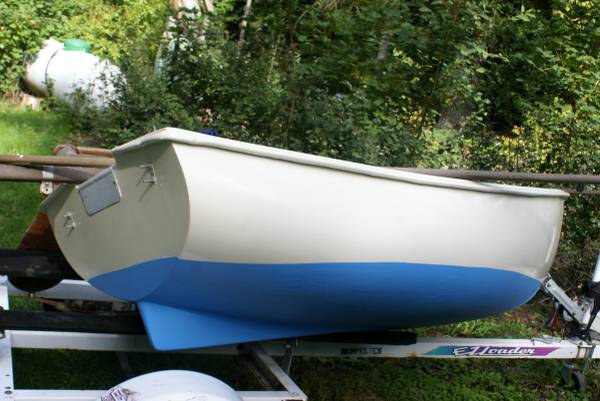
Nowdays, Jolly Boats are considered a desirable type of dingy for cruising boats. There is a class of competition for them as a type of sailing dingy. Fun and stable, they also row well or carry an outboard. There are a few examples online; set up for sailing, recent sold for prices ran around $7000.00
BTW: The length is 2.75 meters. The listing format did not allow that entry.
This (rarity on the West Coast area) came with a live-aboard boat I bought in Florida and it was rowed and/or motored. I started to set it up for sailing but other things got in the way. The point being that there was a mast, boom and rudder that shows in the photos, but they went on another dingy. I had a rigid bottom inflatable that I used while this dinghy sat stored in Florida. My inflatable wore out and I learned to appreciate hard shelled dinghy's more. If I had taken this Jolly boat instead of my inflatable when I left on a 6 year journey, it'd still be in service.
The trailer in the photos is an Easy Loader Jet-ski trailer that belongs to a friend. They seem to run about $1000 or more but since he no longer has a jet-ski, he will let it go for $350 if it goes with the Jolly Boat.
From wikipedia: Historically, Jolly boats were used for transporting people and goods to and from shore, for carrying out inspections of the ship, or other small tasks and duties that required only a small number of people, and did not need the use of the larger boats, such as the launch or cutter. Jolly boats were carried on practically all types of warships of the Royal Navy during the age of sail, from ships of the line down to sloops and brigs.[5] Ships of the line would carry a barge, launch, pinnace, two cutters, all of various sizes, and a jolly boat, while the brigs might carry only a jolly boat and a cutter.[5]
The application of the jolly boat was developed further during the French Revolutionary and Napoleonic Wars, particularly by the frigate commander Sir George Collier.[6] Collier, who was active in the close blockade of the Spanish coast during the Peninsular War, combined the features of a jolly boat with those of a whaleboat and found the result extremely seaworthy and particularly effective in carrying out shore landings.[6] The design was particularly buoyant and was often described as a type of lifeboat. Several captains ordered these boats for their own ships, while the Admiralty considered the possibility of ordering a general replacement of old-style jolly boats with the new 'lifeboat' design on several occasions, but were deterred by the cost.[6] By 1815 however the Stores Committee had authorized the replacement of the old-style jolly boats with the improved versions as and when it proved practical for a ship's commander to carry this out.
A Jollyboat is a sailing dinghy designed by Uffa Fox. It was the fastest dinghy in its day, and was built by Fairey Marine 1953 - 1971.
In the 1950s and 60s, a racing dinghy from Britannia ruled the waves: the Jollyboat. From Massachusetts to Georgia, from Long Island to the Great Lakes, the Jollyboat spread the gospel of high-performance sailing to a new generation of racers.
In addition to it's initial popularity in the UK, a number were imported to the US by George O'Day, an agent for Fairey Marine at the time. Boats were also built and raced in Australia and New Zealand.
Trapezes were legalized in 1959. A few were built of fiberglass by (among others)Columbia Yachts (USA) in the mid 1960's but, reportedly, the technology had not progressed far enough at this time to match the rigidity and light weight of the wood boats. JOLLYBOAT class racing had mostly vanished by 1970.
This rebirthed fiberglass Jolly Boat was made between 1994 -2003 by Jolly Boat of Fort Myers, FL